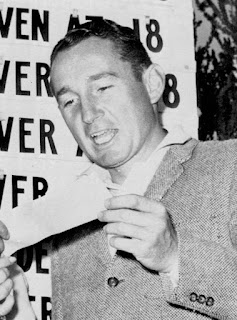
Barney and his friend Hector were playing a round of golf with their wives early on a Sunday. It was a four-ball, better-ball format with a little bit of cash on the line.
Have there been any pairs of brothers in golf history who both won major championships? Yes, there have been several. But they are all in the distant past: The most-recent brothers to join the following list did so in 1960.
Winning The Masters Tournament mean writing one's name in golf's record books. It means the winner's name goes down in history. It also mean someone just banked a whole lot of money.
Johnny Fischer was a prominent amateur golfer in the 1930s whose biggest victory was in the U.S. Amateur. He was famous for pulling off come-from-behind victories. Fischer was also one of the first golfers to win both the NCAA and U.S. Amateur championships, and he was one of the last golfers to win a big tournament playing clubs with wooden shafts.
The U.S. Open is one of the four major championships of men's professional golf. And like all of those majors, it has a cut at the midway point — following the second of four rounds. The golfers who contend in the U.S. Open make a lot of money. But what about the golfers who miss the cut? Do they receive any payout from the U.S. Open prize fund? If so, how much?
What is the lowest stroke total ever scored in a golf tournament on the PGA Tour? That record currently stands at 253, shared by three golfers. The first golfer to record a 253 for 72 holes on the PGA Tour did so in 2017; the most-recent golfer to do so did it in 2025.
Dow Finsterwald had a relatively brief period at the top of his game, from the mid-1950s to early 1960s, but he packed a lot of accomplishments into that period. He was the runner-up at the last match-play PGA Championship, and the winner of the first stroke-play PGA Championship. He recorded the first 61 in PGA Tour history — while still an amateur. He won 12 tournaments and finished second more than twice as many times. He played in four Ryder Cups and captained in another.
The Southgate Ladies Open was a professional golf tournament on the LPGA Tour played from the late 1960s into the mid-1970s. It took place in Kansas, always in August or September. Half of the tournaments played were won by Kathy Whitworth.
Making it into the field at The Masters Tournament is a routine thing for the best golfers, and the thrill of a career for many others. But for all of them, big money awaits for a victory or high finish. But what about for those golfers who miss the cut? Do they get paid? What is the Masters payout, if any, for golfers who miss the cut?
The Charlie Sifford Award is an honor bestowed annually by the World Golf Hall of Fame to recognize the recipients' "spirit in advancing diversity in golf."